

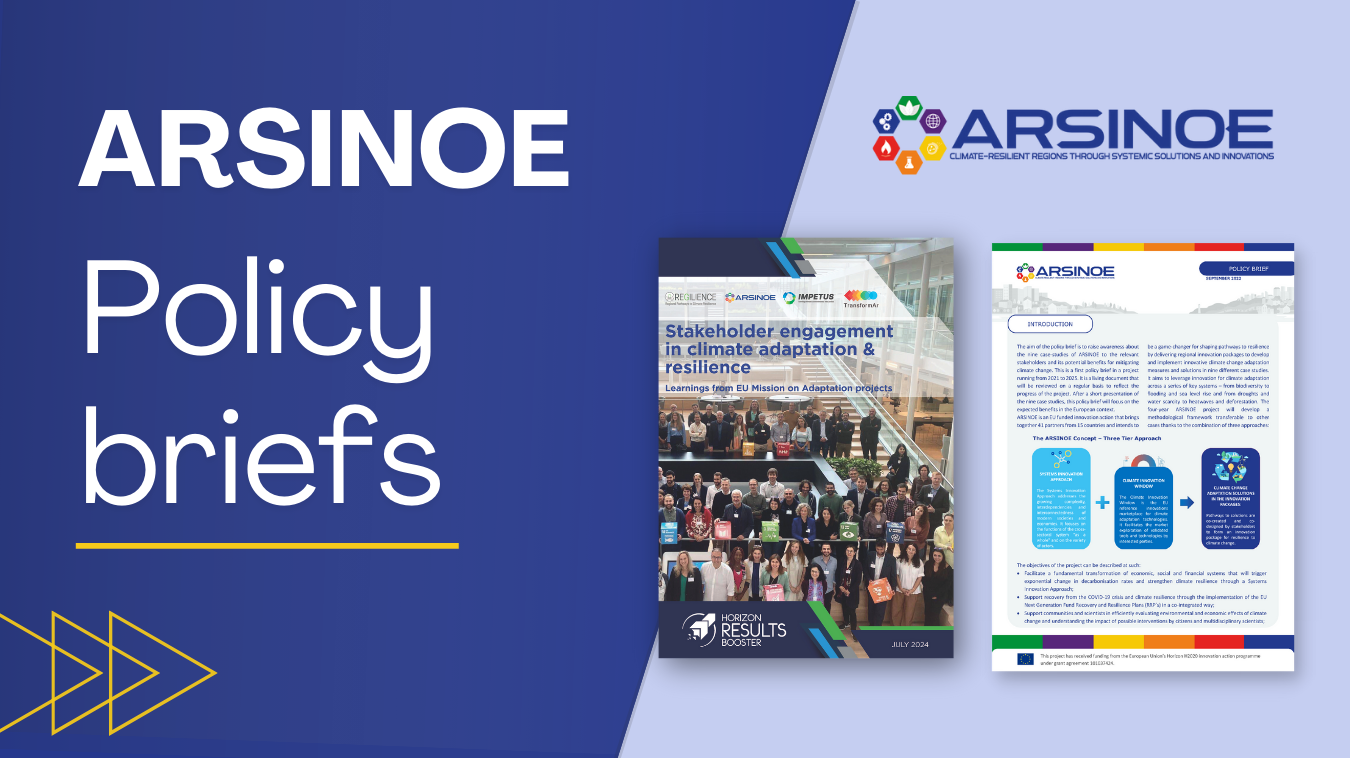
As a cornerstone of its mission to deliver impact, the ARSINOE project has worked towards a comprehensive set of policy recommendations to strengthen Europe’s climate adaptation strategies. These outcomes mark a milestone, transforming real-world experiences into guidance for climate action by decision-makers at all levels.
From Case Studies to Actionable Insights
The recommendations are derived from ARSINOE’s nine demonstrator regions, each addressing unique climate challenges through innovative solutions. To ensure accessibility and practical relevance, the findings have been consolidated into three targeted policy briefs along the life of the project.
The first policy brief (available here) introduced ARSINOE’s systemic approach to implementing EU legislation and designing effective governance models. The second, developed jointly with IMPETUS, REGILIENCE, and TransformAr, focused on Stakeholder Engagement in Climate Adaptation and Resilience, providing practical lessons for local and regional authorities (available here).
In the coming weeks, the ARSINOE third policy brief will be released. Titled “Advancing Systemic Water Resilience in Europe”, the document goes further by translating ARSINOE’s scientific outputs, demonstrator experiences, and stakeholder insights into recommendations for European water and climate policymakers (available [here]).
Key Recommendations for a Resilient Europe
Building on the European Green Deal and aligning with the EU Water Resilience Strategy (COM(2025) 280), the third policy brief highlights measures to address Europe’s water challenges. Its recommendations include:
- Mainstreaming systemic resilience frameworks into the EU Water Acquis by embedding cross-sectoral risk and resilience indicators into River Basin Management Plans and aligning climate-water KPIs in National Energy and Climate Plans.
- Adopting integrated WEFE nexus planning to balance water, energy, food, and ecosystem needs, especially within the Common Agricultural Policy.
- Tailoring water strategies to islands and border regions, with dedicated financial support for their unique challenges.
- Leveraging nature-based and hybrid solutions, as shown in La Palma, Gran Canarias, and the Main River Basin, to restore hydrological cycles, mitigate floods, and foster biodiversity.
- Promoting digital twins and smart forecasting tools, demonstrated in the Black Sea and Torbay case studies, to improve early warning systems and participatory decision-making.
- Supporting participatory governance and emotional intelligence, using ARSINOE’s toolkit to reduce conflicts and foster trust in water-scarce regions.
- Embedding sustainable finance tools in the EU Multiannual Financial Framework and OMNIBUS initiatives, equipping municipalities and stakeholders with instruments such as a Finance Registry and cost-benefit analysis methods to unlock investments in resilience
It will provide a coherent roadmap for operationalising Europe’s climate and water resilience objectives up to 2030 and beyond, bridging the gap between on-the-ground innovation and EU policy frameworks.